


SS Desk
New York, November 27, 2024
The International Criminal Court (ICC) prosecutor’s request for an arrest warrant for Myanmar military commander-in-chief, Sr. Gen. Min Aung Hlaing, for alleged crimes against humanity is a major step towards justice for the country’s Rohingya population, Human Rights Watch said today.
ICC Prosecutor Karim Khan’s announcement during a visit to Bangladesh on November 27 opens the door to seeking accountability for the atrocities of 2016-2017 and eroding the impunity fueling the military’s ongoing abuses.
Khan requested the arrest warrant for Min Aung Hlaing, alleging his responsibility for the crimes against humanity of deportation and persecution of the Rohingya committed in Myanmar and in part in Bangladesh between August and December 2017.
Min Aung Hlaing led the February 2021 coup and remains head of the State Administration Council junta.
The ICC prosecutor’s request for this arrest warrant is a strong warning to Myanmar’s abusive military leaders that they’re not beyond the reach of the law, said Maria Elena Vignoli, senior international justice counsel at Human Rights Watch.
In his announcement, Khan stated that the alleged crimes were committed by “the armed forces of Myanmar, the Tatmadaw, supported by the national police, the border guard police, as well as non-Rohingya civilians.” He also noted that this is the first request by his office for a warrant against a senior Myanmar official, but “more will follow.”
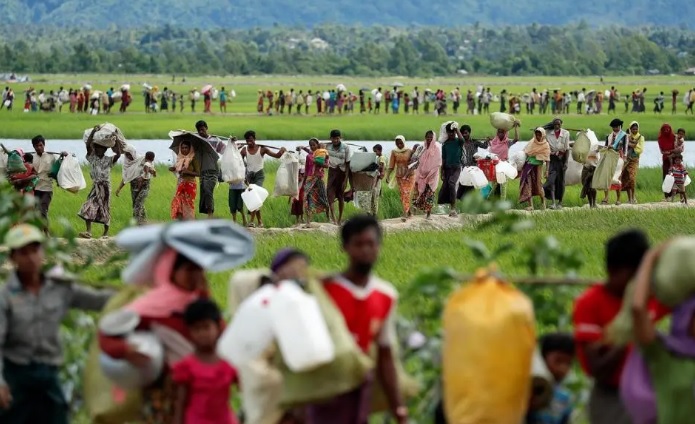
In August 2017, Myanmar security forces began a sweeping campaign of massacres, rape, and arson against Rohingya in northern Rakhine State that forced more than 700,000 to flee to Bangladesh.
Human Rights Watch determined that the atrocities amounted to crimes against humanity and acts of genocide.
Although Myanmar is not an ICC member country, in 2019 the ICC prosecutor opened an investigation into alleged grave crimes against the Rohingya population that were committed, at least in part, in Bangladesh or another ICC member country.
The ICC can only exercise its jurisdiction over crimes committed by nationals of, or on the territory of a member country, unless the situation is referred to the court by the UN Security Council, or if the nonmember country in question accepts the court’s jurisdiction.
The prosecutor’s request has been submitted to ICC judges, who will determine whether to issue the warrant. No time limit is imposed on the judges’ decision. If the judges issue the warrant, ICC member countries will be under a legal obligation to arrest and transfer Min Aung Hlaing to the court if he enters their territories. The ICC does not permit trials in absentia.
No one has yet been held accountable for the 2016-2017 crimes against the Rohingya, while the international response to the Myanmar crisis has been fragmented and halting.
Source: HRW press release